Guide · Updated 28 Sep 2026

RedM minigames: chess, checkers and games players come back to

Players do not stay online for the big events. They stay for the quiet hour in between, and a quiet hour needs something to do that is not a job. A game at a saloon table is that: two players sit down, talk in character while they play, and a crowd gathers when money is on the table. This guide covers what makes a minigame work on a roleplay server, and how to run chess and checkers in particular.

What makes a minigame work in roleplay

  • It happens in the world. A menu game anyone can open anywhere is a phone app. A table in the Saint Denis saloon is a place, and places create scenes.
  • Others can watch. Spectators are half the point: they talk, bet among themselves, and remember who won.
  • It has stakes, and the stakes are safe. A wager makes a game matter. A wager that can be dodged by logging out makes it a scam.
  • It remembers. A rating or a record turns one game into a rivalry.
  • It works alone. On a quiet night there may be nobody to play, so an AI opponent keeps the table useful.

Chess and checkers at the table

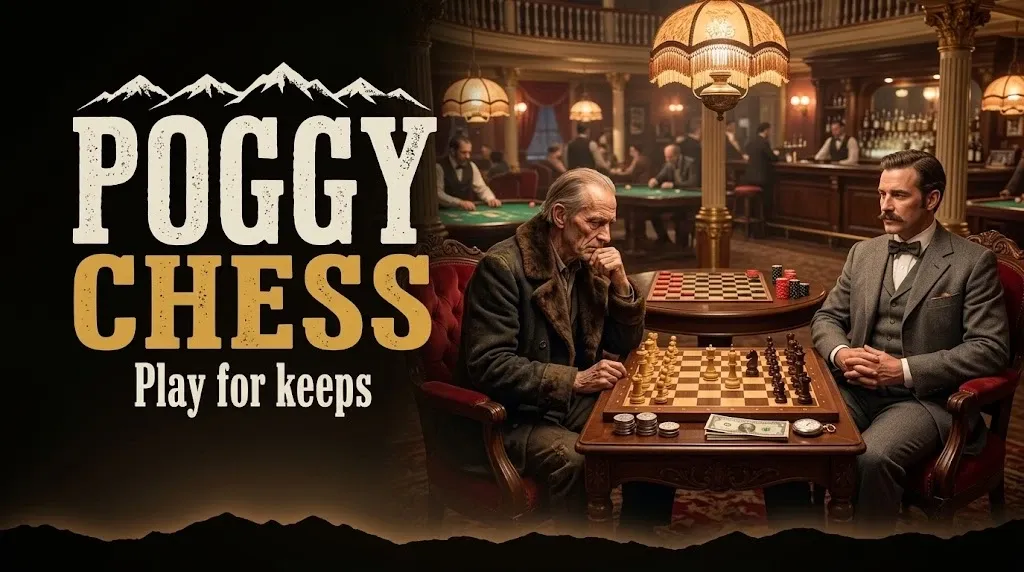
Poggy Chess ($29.99) does all five. It spawns the tables, boards, chairs and pieces itself; characters walk to a chair and sit. Anyone within 20 metres can watch a game in progress.

  • Chess with the full rules: castling, en passant, promotion, and draws by stalemate, repetition, the fifty-move rule or insufficient material. Players can offer a draw or resign.
  • Checkers in American, Russian, Brazilian and Pool rules, plus house rules picked at the table. Captures are taken one jump at a time, and pieces that must capture are ringed, which matters more than it sounds for players who learned different rules.

Either game can be switched off in the config.

An opponent at 3 a.m.

Chess has seven AI levels, from beginner to grandmaster; the default is club. The first four run on the server's own engine. The top three ask Stockfish through chess-api.com, and fall back to the server's engine when that cannot be reached. Checkers has three levels. AI games get hints and an evaluation bar, so they double as a way to learn. They are never rated.

Wagers players cannot dodge

Wagers are the reason people crowd round, and the first thing players will try to exploit. The rules that close the gaps:

  • Both stakes are taken when the game starts, when the second player accepts. If either cannot pay, the game does not start. Nobody plays on credit.
  • Leaving loses. Standing up or leaving the server mid-game loses the game and the stake.
  • Stalling loses. If an opponent stops moving, the other player can claim the win after 5 minutes.
  • Draws and restarts are refunds. A draw, or a game with no result, returns each stake. A server restart returns both, and money owed to someone offline is paid when they next come online.
  • Death is not a strategy. By default a death ends the game with no result and refunds both. The alternative setting, where the player who died loses, turns shooting your opponent into a way to win; leave it off unless that is the roleplay you want.

Wagers can be cash or gold, 1 to 500 by default, and only between two players.

Ratings and records

Each character has an Elo rating for chess and another for checkers, starting at 1200. A player needs five rated games to appear on the leaderboard, which keeps one lucky win from topping it. "My record" lists every game with wins, draws, losses and opponents, and replays any game move by move, which is the part players use to settle arguments.

Games without a wager, AI games included, are saved when a player stands up, and can be picked up again from the same chair.

Where to put the tables

Five tables ship with it, each with a map blip: Blackwater courtyard, and the saloons in Saint Denis, Rhodes and Armadillo, plus Sisika Prison, where a chess game is exactly the kind of roleplay a prison needs. Add your own in /poggy → Chess & Checkers → Tables → Add table, standing where it should go, or in Config.Tables.

Put tables where players already wait: saloons, a train station, a jail, a camp. A table nobody walks past is never played. Two or three well-placed tables beat ten scattered ones.

Running tournaments

A chess night is one of the cheapest events you can run: book a saloon, post the bracket, and let spectators bet in character. RedM event ideas has more on announcing and running events. For a stuck table, /chesstable reset <id> ends the game with no result.

Installing it

Poggy Chess needs Poggy Core (Free) 0.23.0 or newer and oxmysql, and runs on VORP Core, RSG Core and QBCore RedM. Its tables are created on first start. Its config and translation files are open, and /poggy edits most settings in game.

Questions this guide answers

Can you play chess in RedM?

Yes, with a script. Poggy Chess puts chess and checkers tables in saloons and towns, with full chess rules, checkers in four rule sets plus house rules, an AI opponent, wagers and Elo ratings. It runs on VORP Core, RSG Core and QBCore RedM.

How do wagers stay fair if a player leaves?

Both stakes are taken when the game starts. Leaving or standing up loses the game and the stake, a draw returns both, and a server restart returns both. If an opponent stops moving, the other player can claim the win after 5 minutes.

Can killing an opponent win a wagered game?

Not by default. A death ends the game for both players with no result and returns the stakes. There is a setting that makes the player who died lose, and the documentation warns it makes killing an opponent a way to win their money.

Scripts mentioned in this guide

Whole store →
Poggy Chess — RedM Chess and Checkers Script
RedM Chess and Checkers Script

Poggy Chess

Chess and checkers tables placed in the RedM world: play a friend or an AI with seven chess and three checkers levels, four checkers rule sets, wagers held from both players, Elo ratings and a move-by-move record of every game.

Price$29.99
Poggy Core — Free RedM Framework Core and Auto-Updater
Free RedM Framework Core and Auto-Updater

Poggy Core

The free, open-source core every Poggy script runs on, for VORP Core, RSG Core and QBCore RedM: automatic updates with config merging, tables created on start, account bans with a shared anti-cheat ban network, and one API for your own scripts.

PriceFree

RedM Script Subscriptions vs Buying Outright

The break-even maths with live prices, what cancelling does, how updates and licences work, and when each one wins.

Read the guide →

How to Set Up Law Enforcement on a RedM Server

Crime alerts and witnesses, on-duty status and counts, badges, evidence lockers, crime scene text, jail and bounties, and how much law your player count needs.

Read the guide →

How to Install a RedM Script

Download, resources folder, SQL, start order, config and the escrow licence check. Then the five common errors.

Read the guide →

Free RedM Scripts Worth Installing

Eight free scripts, what each one does, what it needs, and what it does not do.

Read the guide →

How to Back Up a RedM Server

The database, resources, configs, licence files and txData. How to automate it, and how to test the restore.

Read the guide →

How to Choose a RedM Script: Checks Before You Buy

Framework claims, performance, open config, versions, support and video. Ten checks, and the red flags that should end the sale.

Read the guide →

How to Add Items to a RedM Server

Where each framework keeps its item list and icons, how to add an item to each, and the mistakes that break scripts.

Read the guide →

RedM /me and /do Commands: Roleplay Tools Guide

Writing a good /me and /do, overhead text or chat, scene text, status labels, skillchecks instead of dice, animations, and keeping it all clean.

Read the guide →

RedM Server Event Ideas and How to Run Them

Eight events that bring players back, how to run each, when to schedule and announce them, prizes that keep the economy intact, and a checklist.

Read the guide →

RedM Admin Tools: Moderating a Roleplay Server

txAdmin, ACE permissions, framework admin menus, admin blips, reports and evidence, staff ranks, and a moderation checklist.

Read the guide →

Best RedM Scripts for a New Server

Economy, law, activities, roleplay tools and admin utilities. What to run, what it costs, and where the free options are.

Read the guide →

VORP vs RSG Core vs QBCore for RedM

Script availability, structure and inventory for each framework, and what "runs on VORP, RSG and QBCore" actually means.

Read the guide →

How to Update RedM Scripts Without Breaking Your Config

The manual routine that keeps your config safe, and the automatic route that removes the routine.

Read the guide →

RedM Server Economy: How to Balance Money, Jobs and Shops

Sources, sinks, player shops, auctions, jobs and a stipend. The model, the starting numbers and the scripts.

Read the guide →

How to Set Up Jobs on a RedM Server

Job names and grades, duty, several jobs per character, badges, and making every script agree.

Read the guide →

Cfx Escrow Explained for RedM Server Owners

Which files are encrypted, what you can still change, the licence file, and the error everyone hits once.

Read the guide →

RedM Server Performance: How to Reduce Lag

Measure first, then the usual causes: hot client loops, dead entities, unindexed queries and NPC systems tuned too high.

Read the guide →

Using Poggy Core in Your Own RedM Scripts

The free framework layer under your own resources: install, first script, menus, storage, jobs, standalone mode, diagnostics.

Read the guide →

How to Run a Player Economy on a RedM Server

Player-owned shops, auctions, taxes, moving prices and the weekly checks that keep a live economy healthy.

Read the guide →

How to Set Up Crafting on a RedM Server

Recipe chains, benches and campfires, job locks, skillchecks, telling players where ingredients come from, and pricing it all.

Read the guide →

How to Set Up Fishing on a RedM Server

What makes fishing worth playing, installing it, bait and seasons, tuning the difficulty, and pricing the catch.

Read the guide →

How to Make a RedM Server

Server artifacts, txAdmin, the licence key, server.cfg, the database, a framework, ports, admins, backups and a launch checklist.

Read the guide →

RedM Animations: Dictionaries, Scenarios, Emotes

Dictionaries, clips and scenarios, playing one from Lua, props on bones, multi-step scenes, syncing, cleanup and emotes players use.

Read the guide →

How to Handle Player Reports and Tickets on a RedM Server

Tickets in game instead of in Discord DMs: roles, replies, internal notes, the warn-kick-ban ladder and Discord posts.

Read the guide →

How to Stop Banned Players Coming Back to Your RedM Server

Account bans that match every identifier, why IP bans are a trap, and a shared network that stops a known cheater at the door.

Read the guide →

How to Set Up Player Storage on a RedM Server

Chests players place and share, job storages, prices and upgrades, and the per-framework stash rules that lose items when ignored.

Read the guide →

How to Add Emotes to a RedM Server

An emote menu players actually use: search, favourites, preview, nearby chairs and railings, custom emotes with props, and what to hide.

Read the guide →
Join the Discord Discord